
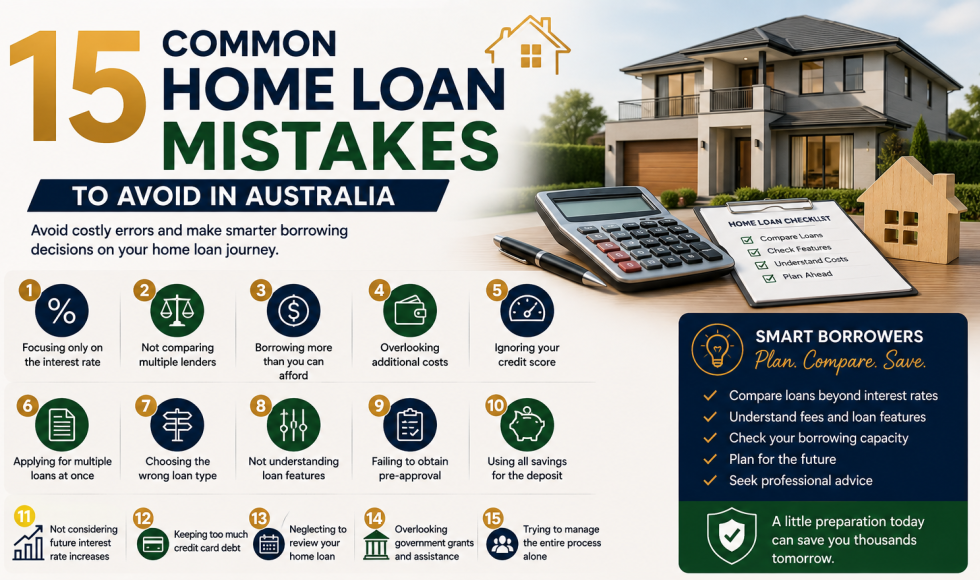
Common Home Loan Mistakes to Avoid: A Complete Guide for Australian Borrowers
Buying a home is one of the biggest financial commitments most Australians will ever make. Whether you’re purchasing your first home, refinancing an existing mortgage, or investing in property, the decisions you make during the borrowing process can have long-term financial consequences.
Unfortunately, many borrowers focus exclusively on securing loan approval and overlook important factors that could affect their finances for years to come.
Choosing the wrong loan, borrowing beyond your means, overlooking hidden costs, or failing to compare lenders can result in higher repayments, unnecessary interest expenses, and financial stress.
The good news is that most mortgage mistakes are avoidable.
In this guide, we’ll explore the most common home loan mistakes and explain how you can avoid them to make smarter borrowing decisions.
Mistake #1: Focusing Only on the Interest Rate
One of the biggest mistakes borrowers make is choosing a lender solely because they offer the lowest advertised interest rate.
While the interest rate is undoubtedly important, it shouldn’t be the only factor influencing your decision.
A home loan is much more than a percentage.
You should also consider:
- Loan fees
- Offset accounts
- Redraw facilities
- Flexible repayment options
- Customer service
- Fixed versus variable rates
- Refinancing options
A loan with a slightly higher interest rate but better features may save you more money over time.
Mistake #2: Not Comparing Multiple Lenders
Many borrowers apply directly through their everyday bank without exploring alternative lenders.
Although this may seem convenient, it can limit your options.
Different lenders have different:
- Lending policies
- Interest rates
- Deposit requirements
- Loan products
- Eligibility criteria
One lender may reject an application, while another may approve it under the same circumstances.
Comparing multiple lenders allows you to identify the most suitable loan for your financial situation.
Mistake #3: Borrowing More Than You Can Comfortably Afford
Receiving approval for a large loan doesn’t necessarily mean you should borrow the maximum amount available.
Lenders calculate borrowing capacity based on a variety of factors, but their assessment may not fully reflect your lifestyle, future plans, or personal circumstances.
Before deciding on a loan amount, consider:
- Future interest rate increases
- Childcare expenses
- Career changes
- Family planning
- Rising living costs
Always leave room in your budget for unexpected expenses.
A comfortable mortgage today can become financially stressful if circumstances change.
Mistake #4: Overlooking Additional Property Purchase Costs
Many home buyers focus exclusively on saving for a deposit while underestimating the additional costs associated with purchasing a property.
These costs may include:
- Stamp duty
- Legal fees
- Building inspections
- Pest inspections
- Loan application fees
- Mortgage registration fees
- Moving expenses
These expenses can add thousands of dollars to the total cost of purchasing a home.
Understanding these costs in advance can help you create a more realistic budget.
Mistake #5: Ignoring Your Credit Score
Your credit score plays an important role in the home loan approval process.
Some borrowers only review their credit history after submitting a mortgage application.
Unfortunately, this can create unexpected problems.
Common credit-related issues include:
- Missed repayments
- Outstanding debts
- Multiple loan applications
- Credit card defaults
Before applying for a home loan, review your credit report and address any issues that could affect your application.
Mistake #6: Applying for Multiple Loans Simultaneously
Some borrowers submit applications to multiple lenders, hoping to increase their chances of approval.
However, multiple credit inquiries within a short period can negatively affect your credit profile.
Every formal credit application may appear on your credit report.
Instead of applying to multiple lenders independently, consider working with a mortgage broker who can assess your eligibility before submitting an application.
Mistake #7: Choosing the Wrong Loan Type
Not all home loans are the same.
Many borrowers choose a loan without fully understanding how it works.
Common loan options include:
Fixed-Rate Loans
Provide predictable repayments.
Variable-Rate Loans
Offer greater flexibility but may fluctuate with market conditions.
Interest-Only Loans
Provide lower initial repayments but may increase long-term borrowing costs.
Split Loans
Combine fixed and variable loan components.
Understanding the advantages and disadvantages of each option is essential before making a decision.
Mistake #8: Not Understanding Loan Features
Modern home loans often include features designed to improve flexibility and reduce interest costs.
Many borrowers fail to take advantage of these features.
Offset Accounts
An offset account reduces the amount of your loan on which interest is calculated.
Redraw Facilities
A redraw facility allows you to access additional repayments you’ve already made.
Additional Repayments
Extra repayments can help reduce your loan balance more quickly.
Choosing a loan without considering these features can result in missed opportunities to save money.
Mistake #9: Failing to Obtain Pre-Approval
Some buyers begin searching for properties before obtaining loan pre-approval.
This can lead to disappointment if they discover they can’t borrow as much as they expected.
Pre-approval provides:
- A realistic budget
- Greater negotiating power
- Faster decision-making
- More confidence during the buying process
Although pre-approval doesn’t guarantee final approval, it can help you understand your borrowing position.
Mistake #10: Using All Your Savings for the Deposit
Many buyers use every available dollar to maximize their deposit.
While a larger deposit can reduce borrowing costs, it’s equally important to maintain an emergency fund.
Unexpected expenses after purchasing a property may include:
- Appliance replacements
- Repairs
- Insurance costs
- Rate increases
Maintaining financial reserves can provide greater peace of mind.
Mistake #11: Not Considering Future Interest Rate Increases
Interest rates can change over time.
Some borrowers calculate affordability based only on current repayments.
However, lenders often apply an interest-rate buffer when assessing applications because they recognize that rates may increase.
Before committing to a loan, ask yourself:
- Could I still afford my mortgage if rates increased by 2%?
- Would my current budget remain sustainable?
Planning for higher repayments can reduce future financial stress.
Mistake #12: Keeping Too Much Credit Card Debt
Credit cards can significantly reduce borrowing capacity.
Even if your cards have no outstanding balances, lenders typically consider your approved credit limits when assessing your application.
For example:
A borrower with three credit cards and a combined limit of $30,000 may qualify for a smaller mortgage than someone with no credit cards.
Reducing unnecessary credit limits before applying for a home loan may improve borrowing capacity.
Mistake #13: Neglecting to Review Your Home Loan
Many borrowers remain with the same lender for years without reviewing their mortgage.
However, the lending market changes constantly.
A loan that was competitive five years ago may no longer be the best option.
Regular loan reviews can help you identify opportunities to:
- Lower your interest rate
- Reduce monthly repayments
- Access better loan features
- Consolidate debt
- Use equity more effectively
Experts often recommend reviewing your mortgage at least once a year.
Mistake #14: Overlooking Government Grants and Assistance Programs
Australia offers several government initiatives designed to support eligible home buyers.
Depending on your circumstances, you may qualify for:
- First Home Owner Grants
- Stamp duty concessions
- Deposit assistance programs
- Government guarantee schemes
Failing to investigate these programs could mean missing valuable financial support.
Mistake #15: Trying to Manage the Entire Process Alone
The home loan process can be complex.
Borrowers must compare lenders, understand loan products, prepare documentation, and navigate lending requirements.
Many buyers attempt to manage everything independently.
Working with an experienced mortgage broker can simplify the process.
A broker can help you:
- Compare loan products
- Assess borrowing capacity
- Prepare documentation
- Identify suitable lenders
- Navigate changing lending policies
How to Avoid These Common Mortgage Mistakes
Before applying for a home loan, remember these key principles:
Compare lenders.
Don’t settle for the first loan you find.
Understand your budget.
Borrow what you can comfortably afford.
Maintain a financial buffer.
Unexpected expenses are inevitable.
Review your credit profile.
Address any issues before submitting your application.
Seek professional advice.
A well-informed decision today can save you thousands of dollars over the life of your mortgage.
Final Thoughts
A home loan is a long-term financial commitment that deserves careful consideration.
Avoiding common mistakes can help you reduce costs, improve financial flexibility, and create a more positive borrowing experience.
The most successful borrowers aren’t necessarily those who secure the lowest interest rate. They’re the borrowers who understand their options, plan carefully, and make informed decisions.
At Suncrest Finance, we believe that education is the foundation of better financial decisions.
Whether you’re purchasing your first home, refinancing an existing loan, or exploring investment opportunities, we’re here to provide transparent, professional, and personalized mortgage advice.
Ready to take the next step? Contact Suncrest Finance today and let us help you find a loan solution that supports your long-term goals.
Frequently Asked Questions
What is the most common home loan mistake?
Focusing exclusively on the interest rate while overlooking loan features, fees, and flexibility is one of the most common mistakes borrowers make.
How often should I review my home loan?
Most borrowers should review their mortgage annually to ensure they’re still receiving competitive rates and suitable loan features.
Does my credit score affect my home loan application?
Yes. Your credit score can influence both your eligibility and the loan options available to you.
Should I obtain pre-approval before looking for a property?
Yes. Pre-approval helps you understand your borrowing capacity and can strengthen your position when negotiating with sellers.