
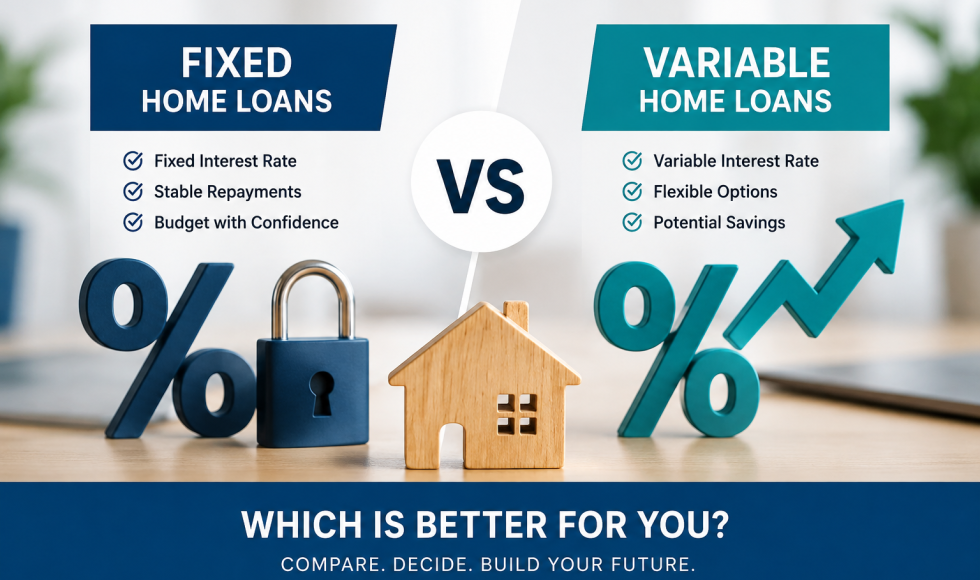
Fixed vs Variable Home Loans: Understanding the Differences.
Choosing the right home loan is one of the most important financial decisions you’ll make. One of the first questions many borrowers face is whether to choose a fixed-rate home loan or a variable-rate home loan.
Both options have advantages and disadvantages, and the best choice depends on your financial goals, risk tolerance, and personal circumstances.
In this guide, we’ll explain how fixed and variable home loans work, compare their key features, and help you determine which option may be suitable for your situation.
What Is a Fixed-Rate Home Loan?
A fixed-rate home loan allows you to lock in your interest rate for a specified period, typically between one and five years.
During the fixed period:
- Your interest rate remains unchanged.
- Your minimum repayments remain the same.
- You are protected from interest rate increases.
For example, if you fix your loan at 5.89% for three years, your repayments will remain based on that rate regardless of market interest rate movements during the fixed period.
Advantages of Fixed-Rate Loans
Repayment Certainty
One of the biggest benefits of a fixed-rate loan is predictability. You’ll know exactly how much your repayments will be throughout the fixed term.
This can make budgeting easier, especially for:
- First home buyers
- Young families
- Borrowers with tight household budgets
Protection from Rate Increases
If interest rates rise during your fixed period, your repayments won’t increase.
For example, if market rates rise by 1%, borrowers on variable rates may face higher repayments, while borrowers on fixed rates remain protected until the end of their fixed term.
Peace of Mind
Many borrowers value the certainty of knowing their loan repayments won’t change unexpectedly.
Disadvantages of Fixed-Rate Loans
Limited Flexibility
Fixed loans often restrict:
- Additional repayments
- Redraw facilities
- Offset account functionality
Some lenders may allow these features, but usually with limitations.
Break Costs
If you refinance, sell your property, or significantly alter your loan during the fixed period, break costs may apply.
These costs can sometimes be substantial.
Missing Out on Rate Reductions
If market interest rates fall, your fixed rate generally remains unchanged until the fixed period ends.
This means you may not benefit from lower rates available to variable-rate borrowers.
What Is a Variable-Rate Home Loan?
A variable-rate home loan has an interest rate that can change over time.
The lender may increase or decrease the rate based on:
- Reserve Bank cash rate movements
- Funding costs
- Market conditions
- Individual lender decisions
As interest rates change, your repayments may also change.
Advantages of Variable-Rate Loans
Greater Flexibility
Variable loans often include features such as:
- Unlimited extra repayments
- Offset accounts
- Redraw facilities
- Easier refinancing
These features can help borrowers pay down their loan faster and manage cash flow more effectively.
Potential Savings When Rates Fall
If interest rates decrease, your repayments may reduce accordingly.
This can create significant savings over the life of your loan.
Easier Loan Management
Variable loans generally allow greater flexibility if your financial circumstances change.
Disadvantages of Variable-Rate Loans
Repayment Uncertainty
Because rates can move up or down, monthly repayments may change.
This can make budgeting more challenging.
Exposure to Rising Rates
When interest rates increase, borrowers may face higher repayments.
For households with limited financial buffers, this can place pressure on budgets.
Fixed vs Variable: Side-by-Side Comparison
| Feature | Fixed Rate | Variable Rate |
|---|---|---|
| Repayment Certainty | High | Low |
| Protection from Rate Rises | Yes | No |
| Benefit from Rate Cuts | No | Yes |
| Offset Account | Limited | Usually Available |
| Redraw Facility | Limited | Usually Available |
| Extra Repayments | Often Restricted | Usually Flexible |
| Refinancing Flexibility | Lower | Higher |
| Budgeting Simplicity | Excellent | Moderate |
Which Loan Is Better for First Home Buyers?
Many first home buyers value certainty because they’re adjusting to the costs of home ownership.
A fixed-rate loan may provide confidence and budgeting stability during the early years of a mortgage.
However, first home buyers should also consider whether features such as offset accounts and extra repayments could be beneficial.
In some cases, a variable loan may offer greater flexibility.
Which Loan Is Better for Property Investors?
Investors often prioritise:
- Cash flow management
- Flexibility
- Access to offset accounts
As a result, many investors favour variable-rate loans.
Others may choose fixed rates when they want certainty around investment expenses.
The right choice depends on the investor’s strategy, portfolio goals, and risk appetite.
What Is a Split Loan?
A split loan combines both fixed and variable components.
For example:
- 50% of the loan fixed
- 50% of the loan variable
This approach allows borrowers to enjoy some repayment certainty while retaining access to flexible loan features.
Benefits of Split Loans
- Balance between certainty and flexibility
- Partial protection against rate increases
- Access to variable loan features on part of the loan
For many borrowers, a split loan provides a practical middle ground.
Questions to Ask Before Choosing a Home Loan
Before deciding between fixed and variable rates, consider:
How Stable Is My Income?
If predictable repayments are important, a fixed rate may be appealing.
Can I Handle Higher Repayments?
Borrowers with strong cash flow may be more comfortable with variable rates.
Do I Want an Offset Account?
Offset accounts are often more readily available with variable-rate loans.
Am I Planning to Refinance or Sell Soon?
Fixed loans may involve break costs if circumstances change.
Do I Value Certainty or Flexibility?
Your answer to this question often guides the decision.
Common Mistakes to Avoid
Focusing Only on Interest Rates
The lowest rate isn’t always the best loan.
Consider:
- Fees
- Features
- Flexibility
- Long-term suitability
Ignoring Loan Features
Offset accounts, redraw facilities, and extra repayment options can significantly impact long-term outcomes.
Not Reviewing the Loan Regularly
A home loan should be reviewed periodically to ensure it continues to meet your needs.
The Bottom Line
There is no universal answer to whether a fixed-rate or variable-rate home loan is better.
A fixed-rate loan offers certainty and protection from rising rates, while a variable-rate loan provides flexibility and the potential to benefit from future rate reductions.
For some borrowers, a split loan may offer the best of both worlds.
The right choice depends on your financial goals, income stability, risk tolerance, and long-term plans.
Before making a decision, it’s important to compare your options carefully and seek professional guidance tailored to your circumstances.
Need Help Choosing the Right Home Loan?
At Suncrest Finance, we help borrowers compare loan options from a range of lenders and understand the advantages and disadvantages of different loan structures.
Whether you’re buying your first home, refinancing, or investing in property, we’re here to help you make an informed decision with confidence.
Contact Suncrest Finance today for a complimentary home loan consultation.
3 Comments
Riva Collins
December 25, 2018 - 3:33 pmIt’s no secret that the digital industry is booming. From exciting startups to need ghor global and brands, companies are reaching out.
Obila Doe
December 25, 2018 - 3:42 pmIt’s no secret that the digital industry is booming. From exciting startups to need ghorglobal and brands, companies are reaching out.
Arnold Rio
December 25, 2018 - 3:44 pmIt’s no secret that the digital industry is booming. From exciting startups to need ghorglobal and brands, companies are reaching out.