
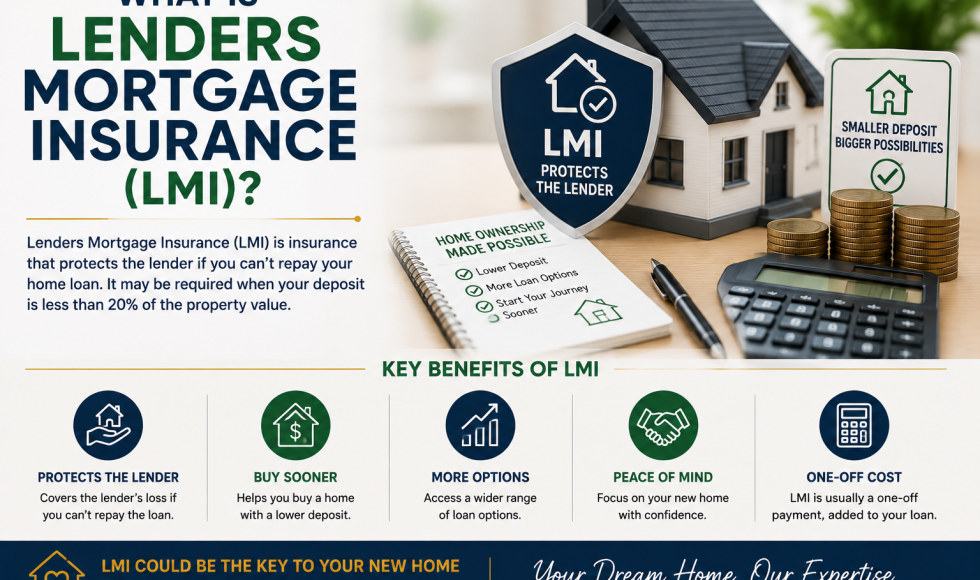
What Is Lenders Mortgage Insurance (LMI)? A Complete Guide for Australian Home Buyers.
Introduction
If you’re planning to buy a home with less than a 20% deposit, you’ve probably come across the term Lenders Mortgage Insurance (LMI).
For many first home buyers, LMI can be confusing. One of the most common misconceptions is that LMI protects the borrower. In reality, it protects the lender if the borrower defaults on their home loan.
Understanding how LMI works can help you make informed decisions about your deposit, borrowing strategy, and overall home buying costs.
In this guide, we’ll explain what LMI is, when it applies, how much it can cost, and whether paying LMI could actually help you enter the property market sooner.
What Is Lenders Mortgage Insurance (LMI)?
Lenders Mortgage Insurance is an insurance policy that protects the lender when a borrower has a smaller deposit and therefore represents a higher lending risk.
In most cases, LMI is required when a borrower has:
- Less than a 20% deposit
- A Loan-to-Value Ratio (LVR) above 80%
Although the borrower usually pays the premium, the insurance protects the lender—not the borrower.
Simple Example
Let’s assume:
Property Value: $800,000
Deposit: $80,000 (10%)
Loan Amount: $720,000
LVR: 90%
Because the borrower is contributing only 10%, the lender may require LMI before approving the loan.
Why Do Lenders Require LMI?
From a lender’s perspective, borrowers with smaller deposits present greater risk.
If property values decline or the borrower defaults, the lender may not recover the full loan balance through the sale of the property.
LMI helps reduce that risk.
As a result, lenders are often willing to lend larger amounts to borrowers who have smaller deposits.
Without LMI, many borrowers would need to wait significantly longer to save a larger deposit before purchasing a home.
What Is Loan-to-Value Ratio (LVR)?
LVR is one of the key factors used to determine whether LMI is required.
LVR measures the size of your loan compared to the value of the property.
Formula
Loan Amount ÷ Property Value × 100
Example
Property Value: $900,000
Loan Amount: $810,000
LVR:
$810,000 ÷ $900,000 × 100 = 90%
In this example, the borrower has a 10% deposit and may be required to pay LMI.
When Does LMI Usually Apply?
While policies vary between lenders, LMI commonly applies when:
- LVR exceeds 80%
- Deposit is less than 20%
- Borrower risk is considered higher
Some lenders may have additional requirements depending on:
- Employment type
- Credit history
- Property type
- Loan purpose
How Much Does LMI Cost?
The cost of LMI varies depending on several factors, including:
Property Value
Higher property values generally result in higher LMI premiums.
Deposit Size
Smaller deposits usually lead to higher LMI costs.
Loan Amount
Larger loans often attract higher premiums.
Lender Policies
Each lender uses different pricing models.
Example Only
These figures are illustrative and not indicative of actual lender pricing.
| Property Price | Deposit | Approximate LVR | Potential LMI Impact |
|---|---|---|---|
| $700,000 | 20% | 80% | Often No LMI |
| $700,000 | 10% | 90% | LMI May Apply |
| $700,000 | 5% | 95% | Higher LMI May Apply |
Actual LMI premiums vary significantly and should be confirmed with the lender.
How Is LMI Paid?
Borrowers typically have two options.
Option 1: Pay Upfront
The premium is paid at settlement.
Advantages
- Lower loan balance
- Less interest paid over time
Considerations
- Higher upfront costs
Option 2: Capitalise the Premium
The LMI premium is added to the loan amount.
Advantages
- Lower upfront cash requirement
Considerations
- Larger loan balance
- Interest is generally charged on the premium over time
Many first home buyers choose this option to preserve savings.
Does LMI Protect Me as a Borrower?
No.
This is one of the most misunderstood aspects of LMI.
Even though the borrower pays the premium, the insurance protects the lender.
If a borrower defaults and the lender suffers a loss after selling the property, the insurer may compensate the lender.
In certain circumstances, the insurer may still pursue recovery from the borrower.
Is Paying LMI Always a Bad Thing?
Not necessarily.
Many people focus solely on avoiding LMI, but doing so isn’t always the best financial strategy.
Sometimes paying LMI allows a borrower to enter the property market sooner.
Example
Imagine:
Property Price Today: $800,000
Deposit Saved: 10%
You decide to wait another two years to save a 20% deposit.
If property prices increase significantly during that period, you may end up needing an even larger deposit than originally planned.
In some situations, paying LMI and purchasing earlier may provide a better outcome.
Every situation is different, which is why personalised advice is important.
How Can I Avoid Paying LMI?
Several strategies may help eligible borrowers avoid LMI.
Save a 20% Deposit
The most common approach.
A larger deposit reduces the lender’s risk and often removes the need for LMI.
Use a Guarantor Loan
Some lenders offer guarantor arrangements where eligible family members provide additional security.
This can reduce or eliminate the need for LMI.
Professional advice should always be obtained before entering a guarantor arrangement.
First Home Guarantee
Eligible first home buyers may be able to purchase a property with a smaller deposit without paying LMI under government-supported schemes.
Eligibility criteria and availability apply.
Professional LMI Waivers
Some lenders offer LMI waivers for eligible professionals, including certain:
- Medical practitioners
- Dentists
- Accountants
- Lawyers
- Other approved occupations
Eligibility requirements vary between lenders.
Common LMI Myths
Myth 1: LMI Protects the Borrower
False.
LMI protects the lender.
Myth 2: You Must Have a 20% Deposit to Buy a Home
False.
Many borrowers successfully purchase property with smaller deposits.
Myth 3: LMI Is Always Bad
False.
Sometimes paying LMI allows borrowers to enter the market sooner and begin building equity earlier.
Myth 4: Every Lender Charges the Same LMI
False.
LMI costs and policies vary between lenders.
What Happens If Property Values Fall?
One reason lenders prefer larger deposits is to reduce the risk of negative equity.
Negative equity occurs when:
Loan Balance > Property Value
Larger deposits provide a financial buffer against market fluctuations.
This is one of the reasons lenders use LMI for higher LVR loans.
Should You Wait to Avoid LMI?
The answer depends on several factors:
- Your income
- Deposit growth rate
- Property market conditions
- Long-term goals
- Borrowing capacity
For some buyers, waiting may make sense.
For others, entering the market sooner may provide greater benefits despite paying LMI.
A personalised assessment can help determine the most suitable approach.
Frequently Asked Questions
Can LMI Be Added to My Loan?
In many cases, yes.
Some lenders allow the premium to be capitalised into the loan.
Do All Loans Require LMI?
No.
LMI is generally associated with higher LVR lending.
Can Investors Pay LMI?
Yes.
LMI may apply to both owner-occupied and investment property loans.
Can First Home Buyers Avoid LMI?
Some eligible buyers may qualify through government programs or specific lender policies.
Why Professional Guidance Matters
LMI can significantly impact the total cost of purchasing a property.
A mortgage broker can help:
- Compare lender policies
- Identify LMI waiver opportunities
- Assess government scheme eligibility
- Structure loans effectively
- Evaluate the financial impact of different deposit sizes
Understanding these options may save thousands of dollars over the life of a loan.
The Bottom Line
Lenders Mortgage Insurance is often a necessary part of purchasing a property with a smaller deposit.
While it increases borrowing costs, it can also provide opportunities for buyers to enter the property market sooner rather than waiting years to save a larger deposit.
The key is understanding how LMI works, when it applies, and whether alternative strategies may be available.
Every borrower’s situation is unique, and the right approach depends on your goals, financial position, and property plans.
Need Help Understanding Your Home Loan Options?
At Suncrest Finance, we help borrowers understand deposit requirements, LMI implications, government assistance programs, and lender policies.
Whether you’re a first home buyer, upgrading your home, or purchasing an investment property, we can help you explore your options and make informed decisions.
Contact Suncrest Finance today for a complimentary consultation and personalised home loan assessment.